


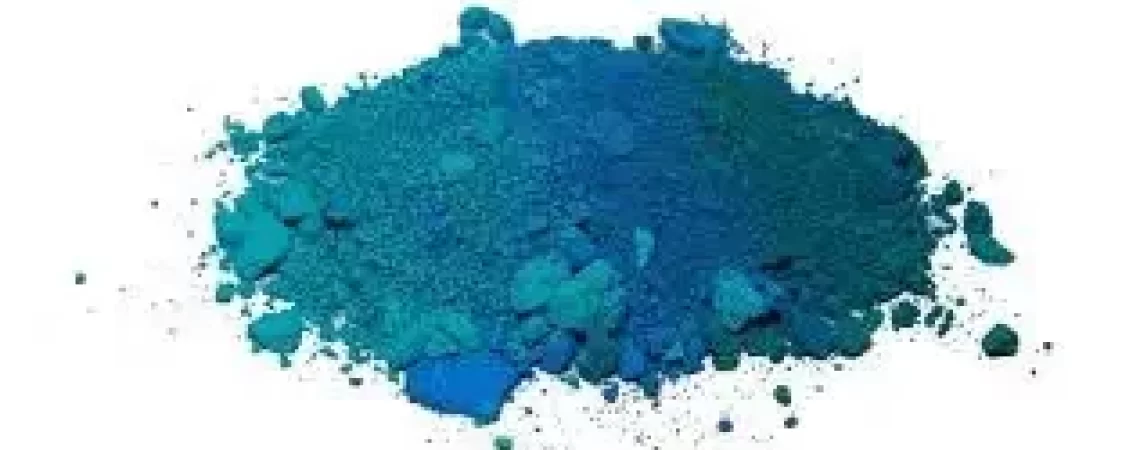
Ultramarine blue, also listed as Pigment Blue 29 or PB29, is an inorganic sodium aluminium silicate pigment that withstands processing temperatures of roughly 300 to 400 degrees Celsius, does not nucleate polyolefin crystallisation, and therefore colours polypropylene and polyethylene without introducing warpage. It carries no heavy metals, does not migrate, and delivers a clean reddish blue shade. Its two real limitations are low tinting strength compared with organic blues and sensitivity to acidic environments, both of which are manageable once you know how to specify around them.
That is the short answer. The rest of this guide covers how to translate it into a working specification: which grade to ask for, what dosage to start at, which polymers behave well, where the pigment is the wrong choice, and how to run a qualification trial that produces a decision rather than more questions.
Ultramarine blue at a glance
| Property | Typical value for PB29 | Why it matters in compounding |
| Colour Index name | Pigment Blue 29 | The identifier to quote on specifications and safety documentation |
| CAS number | 57455-37-5 | Required for regulatory filings and customs declarations |
| Chemical family | Sodium aluminium silicate with polysulfide chromophore | Inorganic lattice, which is the source of its thermal and migration resistance |
| Heat stability | Approximately 300 to 400 C depending on grade and residence time | Covers most polyolefin, styrenic and engineering polymer processing windows |
| Nucleation behaviour in polyolefins | Non-nucleating | No warpage or shrinkage in HDPE and PP mouldings |
| Tinting strength | Low relative to organic blues | Higher loading needed for deep shades |
| Migration resistance | Non-migrating, insoluble | Safe for multilayer and contact-sensitive constructions |
| Lightfastness | High | Suitable for outdoor and long service life parts |
| Acid resistance | Sensitive to acids unless an encapsulated grade is used | Governs suitability for PVC, POM and acid-releasing systems |
| Heavy metal content | None | Simplifies REACH, RoHS and toy safety compliance |
The property most buyers overlook: nucleation
Most pigment comparisons stop at colour and price. For anyone moulding semi-crystalline polymers, the more consequential difference is what the pigment does to crystallisation.
Copper phthalocyanine blue, the usual organic alternative, has a planar molecular structure that acts as a nucleating agent in polypropylene and high density polyethylene. It changes the crystallisation kinetics of the polymer, which alters shrinkage behaviour in the mould. In thin walled and large flat parts the result is warpage: bowed lids, out of tolerance crates, distorted panels.
Ultramarine blue behaves differently because its structure is different. The colour sits inside a rigid aluminosilicate cage rather than in a planar organic molecule, and that cage does not template polymer crystal growth. Published comparative work confirms a markedly lower nucleating effect in HDPE for ultramarine than for copper phthalocyanine.
The practical consequence is straightforward. If your part has tight dimensional tolerances and a semi-crystalline base resin, ultramarine gives you a blue that does not fight the mould.
Where this shows up in real production
- Injection moulded crates, pallets and lids in HDPE and PP
- Thin wall packaging where flatness controls sealing performance
- Large panels and automotive interior parts with visible fit lines
- Any part that already sits near the edge of its dimensional tolerance
If you are colouring these parts and have been troubleshooting warpage, the pigment is worth examining before the mould or the process settings. Our plastics application page covers the wider masterbatch picture.
The second overlooked property: free sulphur
Ultramarine chemistry involves sulphur. Residual free sulphur left in the finished pigment is a processing liability rather than a colour issue, and it is rarely discussed in datasheets.
Free sulphur creates three problems inside a compounding operation:
- Corrosion of metal contact parts. Screws, barrels, breaker plates and dies are all exposed. Corrosion is gradual, so it is usually attributed to the resin or to general wear rather than to the colourant.
- Unwanted reactions with other formulation components. Sulphur can interact with certain stabilisers, antioxidants and metal containing additives, which shifts performance in ways that are difficult to diagnose.
- Working environment quality. Sulphur compounds evolving at processing temperature affect the air around the extruder.
This is the reason our NanoX grade range is manufactured to extremely low free sulphur levels. It is also why we treat free sulphur as a specification line rather than an internal quality note. When you are comparing two ultramarine offers at similar prices, free sulphur content is one of the few variables that changes your maintenance cost rather than your colour cost.
Ask any supplier for a free sulphur figure. A supplier who cannot give you one is not measuring it.
Polymer compatibility
| Polymer | Suitability | Notes for specification |
| Polypropylene (PP) | Excellent | Non-nucleating, no warpage, wide processing window |
| High density polyethylene (HDPE) | Excellent | Same dimensional stability advantage as PP |
| Low density polyethylene (LDPE) | Excellent | Common in film and blow moulding |
| Polystyrene (PS) and ABS | Very good | Good heat stability across normal processing ranges |
| PET | Good | Confirm heat stability at your specific melt temperature and residence time |
| Engineering polymers | Good | Verify against the upper end of your processing window |
| PVC | Requires an acid resistant grade | HCl evolution during processing attacks standard grades |
| POM (acetal) | Requires an acid resistant grade | Formic acid generation is the concern |
| Silicones and rubber | Very good | Widely used, see our rubber application page |
For PVC and POM, specify an encapsulated or acid resistant ultramarine. Standard grades will lose colour and can generate hydrogen sulphide in contact with acid. This is a specification question, not a quality question, and getting it right at the enquiry stage saves a failed trial.
Dosage: where to start
Dosage depends on the effect you want, and ultramarine is used for two quite different jobs.
| Application | Typical starting loading in the final part | Purpose |
| Optical whitening or yellowness correction | Very low, often in the parts per million range | The reddish blue shade neutralises yellow cast in natural resin |
| Pastel and light blue shades | Low, typically well under one percent | Combined with titanium dioxide |
| Medium blue shades | Moderate | Cost per kilo of finished part becomes relevant here |
| Deep or full blue shades | Higher than an organic blue would need | Low tinting strength means more pigment for the same depth |
Two points that matter commercially:
Ultramarine is not the cheapest route to a deep blue. Copper phthalocyanine offers roughly twenty to forty times the tinting strength, so a deep navy will always use less phthalo by weight. If tinting strength alone drove the decision, phthalo would win every time.
It usually is the cheapest route to a dimensionally stable blue. Once you add the cost of scrap from warped parts, the tooling adjustments made to compensate, and the shade of blue you actually wanted, the comparison changes. Our earlier article on cutting costs without cutting quality works through this total cost argument in more detail.
Treat the figures above as starting points for a trial, not as a specification. Actual loading depends on your resin, your titanium dioxide level, opacity target and wall thickness.
Where ultramarine blue is the wrong choice
A guide that only lists advantages is a brochure. These are the situations where you should specify something else:
- You need maximum colour depth at minimum loading. Organic blues will do it with less pigment. If cost per part is dominated by pigment weight and there is no dimensional constraint, phthalocyanine is the rational choice.
- The part lives in an acidic environment and you cannot use an encapsulated grade. Chemical processing components and battery adjacent parts are examples.
- You need a green shade blue. Ultramarine is a reddish blue. No grade will move it to a green undertone.
- Your processing temperature sits above the grade limit with long residence time. Confirm the specific grade rather than assuming the upper end of the general range.
Being clear about these cases is not a weakness in the material. It is what allows a technical buyer to specify with confidence in the cases where ultramarine genuinely is correct.
Six steps to a clean dispersion
Poor dispersion shows up as specks, streaking, inconsistent shade and lower effective colour strength, which then gets misread as a weak pigment. Most dispersion complaints trace back to process rather than product.
Step 1. Confirm particle size distribution before you start. A tight, controlled distribution disperses more easily and agglomerates less. Ask your supplier how particle size is measured and controlled. Our NanoX grades are analysed on Malvern particle size analysers at multiple production stages.
Step 2. Control moisture. Ultramarine blue is hygroscopic. Absorbed moisture causes clumping, poor flow and inconsistent feeding. Store in sealed packaging, keep the storage area dry, and use opened bags promptly.
Step 3. Use adequate shear in the compounding step. Twin screw compounding with a suitable screw configuration will break down agglomerates. Under specified mixing is the most common root cause of speckling.
Step 4. Add a dispersing aid where the system needs it. Wax or polymer based dispersing agents improve wetting, particularly at higher loadings.
Step 5. Check let down ratio and feeder accuracy. Shade variation between production runs is very often a dosing problem rather than a pigment problem. Verify feeder calibration before questioning batch consistency.
Step 6. Keep colour measurement consistent. Measure on the same instrument, same geometry and same sample preparation every time. Comparing plaques moulded under different conditions produces differences that have nothing to do with the pigment.
Compliance and documentation
Ultramarine blue contains no heavy metals, which removes a substantial compliance burden compared with older inorganic blues and with cadmium based colours.
RS Pigments products comply with REACH, RoHS and FDA requirements for cosmetic grade material. Full details of our testing regime are on the quality page.
For food contact plastics, suitability depends on the specific application, the polymer, the contact conditions and the destination market. There is no single answer that covers every case, so please raise your specific end use with our technical team rather than working from a general statement.
Buyers selling into regulated markets may also find our guide to pigment testing and quality standards in Europe useful, and our regional pages set out local supply arrangements for Europe, the USA and Latin America.
How to run a qualification trial that gives you an answer
Trials fail to produce decisions when too many variables move at once. This sequence isolates the pigment.
| Stage | Action | What you are checking |
| 1 | Request samples of two or three candidate grades | Grade selection before volume commitment |
| 2 | Compound at a single fixed loading across all candidates | Like for like colour comparison |
| 3 | Mould a dimensionally sensitive part, not a test plaque | Warpage behaviour under real geometry |
| 4 | Hold at the top of your processing temperature with realistic residence time | Heat stability at your actual conditions, not the datasheet figure |
| 5 | Measure colour on a calibrated instrument, three points per part | Shade consistency and effective strength |
| 6 | Inspect screws and dies after an extended run | Free sulphur effects on tooling |
| 7 | Repeat with a second production batch of the same grade | Batch to batch consistency, the variable that matters most in production |
Stage seven is the one most often skipped and the one that predicts whether a supplier will work for you long term. A grade that performs well once tells you little. A grade that performs identically twice tells you a great deal.
Frequently asked questions
What temperature can ultramarine blue withstand in plastics processing?
Ultramarine blue is generally stable in the range of approximately 300 to 400 degrees Celsius, with the exact limit depending on the grade, the residence time and the polymer system. This covers standard polyolefin, styrenic and most engineering polymer processing. Always confirm the figure for the specific grade at your own processing conditions rather than relying on a general range.
Does ultramarine blue cause warpage in polypropylene?
No. Ultramarine blue is non-nucleating in polyolefins, so it does not alter crystallisation behaviour and does not introduce the dimensional distortion associated with copper phthalocyanine blue in PP and HDPE. This is one of the main technical reasons compounders select it for moulded parts with tight tolerances.
Is ultramarine blue safe and free from heavy metals?
Yes. Ultramarine blue is a sodium aluminium silicate containing no heavy metals. RS Pigments grades comply with REACH, RoHS and FDA cosmetic grade requirements. For food contact applications, suitability depends on the specific end use and destination market, so confirm with our technical team.
Can ultramarine blue be used in PVC?
Only with an acid resistant or encapsulated grade. PVC releases hydrogen chloride during processing, which attacks standard ultramarine and causes colour loss. The same applies to POM. Specify the acid resistant grade at enquiry stage to avoid a failed trial.
Why does ultramarine blue need higher loading than phthalocyanine blue?
Because its tinting strength is considerably lower, roughly twenty to forty times lower than copper phthalocyanine. For deep shades this means more pigment by weight. The trade off is dimensional stability, higher heat resistance and a reddish blue shade that phthalocyanine cannot produce.
What is free sulphur and why should I ask about it?
Free sulphur is residual unreacted sulphur left in the finished pigment. It can corrode processing equipment, react with other formulation components and affect the working environment. It is rarely stated on standard datasheets, which is precisely why it is worth asking about when comparing suppliers.
What is the difference between standard ultramarine blue and NanoX grades?
NanoX grades are produced with precisely controlled particle size distribution, extremely low free sulphur, surface treatment for regular particle shape, and a conditioning and packing process that minimises moisture content. The practical differences are easier dispersion, lower agglomeration risk, reduced abrasion during processing and better batch to batch consistency. Full specifications are on the NanoX page.
Can I get a sample before committing to a volume order?
Yes. We supply trial quantities for laboratory and production scale evaluation, and our technical team can advise on grade selection based on your polymer, processing conditions and shade target before you order. Request a sample here.
Getting the right grade for your line
Specifying ultramarine blue well comes down to four decisions: the correct grade for your polymer, an acid resistant version if your system generates acid, a free sulphur level appropriate to your equipment, and a particle size specification that suits your dispersion capability.
RS Pigments has manufactured ultramarine pigments for over ninety years and supplies more than thirty five countries from our facility in Hathras, Uttar Pradesh. We produce ultramarine blue, ultramarine violet and the NanoX range for plastics, rubber, inks, paints, paper and laundry and textile applications.
If you are evaluating a blue pigment for a masterbatch or compounding application, the fastest route to an answer is a sample tested on your own line under your own conditions.
Request a free sample and speak to our technical team
Tell us your polymer, processing temperature, target shade and any dimensional constraints, and we will recommend a grade before you trial.
You can also meet our technical team in person at the trade shows and exhibitions we attend across Europe, the Americas and Asia, or read more about RS Pigments.
About the author
Written by the RS Pigments technical team, drawing on manufacturing experience across ultramarine blue and violet production and application support for masterbatch producers in more than thirty five countries. Reviewed for technical accuracy prior to publication.